
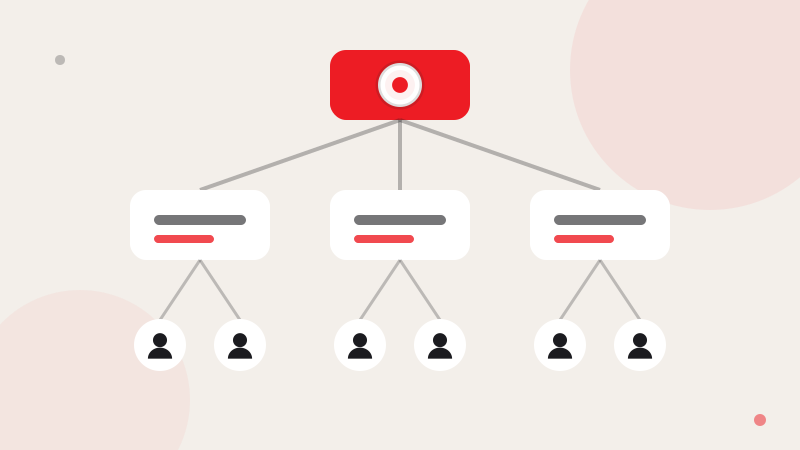
OKRs, short for Objectives and Key Results, are a goal-setting framework. They create alignment, rally everyone around a shared vision, and follow a simple pattern: we will move toward [OBJECTIVE], and we'll know we have by hitting [KEY RESULTS].
Objectives state where the company wants to go, in short, ambitious, and direct terms. Key results spell out how you'll get there and how you'll measure progress along the way, so they need to be quantifiable. Most teams run OKRs in quarterly cycles.
Here is a simple example. Objective: "Become the employer of choice in our region." Key results: "Raise our employee survey engagement score by 10 points," "Cut first-year turnover to below 12%," and "Fill 80% of open roles through referrals or direct applications."
Andy Grove, Intel's former CEO, is credited with creating OKRs. The idea at the heart of the framework is straightforward: take big ambitions (objectives) and split them into clear, measurable outcomes (key results) that a team can actually manage. Grove introduced this strategic planning approach in 1983, and fellow Intel alumnus John Doerr spent decades championing it, yet OKRs only became widespread fairly recently. Today they're used by fast-growing startups and by large companies such as Google.
Objectives describe the vision. They are qualitative and ambitious, stretching without being pure fantasy, and they give a team something to rally around. Because everyone can see them, they build transparency and alignment across the organization. One caution: an objective shouldn't just be a bigger version of something you already do well. It should push into new territory.
Key results are the milestones that make up the bigger picture. They work like road signs, showing whether the team is heading the right way and how much further it has to go. They must be measurable and balanced, supporting your ambitious plans rather than watering them down. Aim for key results that are hard to hit but worth celebrating when you do.
Compared with annual planning, OKRs let you spot and tackle problems before they escalate and adjust budgets as you go. The approach is more flexible, transparent, and focused, it makes the organization collectively smarter, and it discourages teams from padding or hiding budget.
Well-chosen OKRs fuel growth, and they also strengthen employee engagement. People who see that their work matters, and that they can grow with the company, tend to be more motivated. They stretch themselves, act as team players, and look for creative ways to help their team hit its OKRs.
Setting good OKRs takes some practice, but once you've worked through the steps below, rolling them out will feel more natural than you might expect.

This guide is for CEOs, HR and people leaders, and managers who want to sharpen or rethink the way their company sets goals.
If you already use Objectives and Key Results, it's still worth refreshing your understanding of the method and reviewing your approach at the end of each cycle.
A clear company vision
Where do you want the business to be in three to five years? Answering that question gives your goal-setting a concrete, actionable direction.
Priorities for the coming months and years
A vision like "We want to lead our market" is only a starting point. Work out what has to happen to get there. Does annual recurring revenue need to double within a set number of years? The more specific the aim, the more easily it breaks down into OKRs that serve the vision.
- Get specific and embrace numbers. Key results have to be measurable so you can track progress and know when to change course or raise the bar.
- Avoid open-ended results such as "keep growing our newsletter audience." That isn't a key result. Name a concrete target instead, such as "grow newsletter subscribers by 20% by the end of Q2."
- For the same reason, avoid verbs like "maintain" or "keep doing." Key results should be specific and move you forward. The exception is a situation where holding steady is the real challenge, such as protecting your customer base during an economic downturn.
- Several departments can share a key result. Just give it a clear owner and make sure everyone involved checks in with one another regularly.
- Goal trees are an effective way to show how company, team, and individual objectives connect. Goal-tracking software makes ownership and dependencies much easier to see on the way to success.
- Reaching 100% of a key result is satisfying, but it may mean your targets weren't ambitious enough to drive the fastest possible growth. Set bold OKRs with clear expectations. Google treats 60–70% achievement as the "sweet spot," though you can adjust that range to suit your company (aiming for 75–80%, for example).
Who this step is for: managing directors and C-suite leaders
Once your vision and priorities are clear, take the next step and turn those priorities into goals for the company as a whole.
These company-level goals, sometimes called parent goals, shape the more detailed OKRs that follow in the next step. This cascading approach to goals keeps the entire organization aligned.
Even if you run quarterly OKRs, parent goals usually cover a full year. Typical focus areas include:
- Revenue
- Hiring
- Customer acquisition
- Brand
Who this step is for: managing directors, C-suite leaders, and team leads
Now work out the part each team plays in achieving the parent goals. Sit down with every department head and discuss how their team can move the vision forward.
Take a product team as an example. It could support revenue goals by shipping the features customers request most often, and support hiring goals by partnering with HR to give candidates a realistic, behind-the-scenes look at how the team works.
As noted above, company-level goals sometimes warrant a longer horizon, but for team-level OKRs we recommend working in quarterly cycles.
Who this step is for: department heads and their teams
Three to five objectives per cycle keeps a team challenged without overloading it. Fewer than that can feel restrictive and uninspiring; more than that spreads focus so thin that little actually gets done.
Who this step is for: department heads and their teams
Before deciding how many key results to set, weigh the size of your team, how complex your OKR setup is, and how broad the objective is. Don't add key results just to make the plan look more demanding. Keep it simple: key results are there to help you reach goals, not to create busywork.
Rather than handing down assignments, ask your team how they'd like to contribute. Put a few questions to yourself and to them. Is there a need, or room, for a dedicated project? Is someone keen to own a particular part of the objective? How can the team as a whole, and each individual, move the goal forward?
Inviting input instead of presenting a finished plan encourages people to take initiative, which builds engagement and a sense of purpose. That openness, combined with trust in what your team can do, is what lets OKRs flourish.
Keep in mind that every OKR must line up with company goals. Department heads and their teams draft the OKRs, but they should be signed off to confirm alignment.
Optional: in addition to team OKRs with clear owners, you can introduce individual OKRs. These might focus on skills someone wants to build that also serve the company's growth and vision. We suggest saving individual OKRs for organizations that already have solid experience with the framework.
Who this step is for: everyone involved
Keep OKRs healthy by tracking progress, talking about goals regularly, and acknowledging every achievement. Recognizing your team's wins, large or small, or factoring them into merit increases keeps everyone engaged and keeps OKRs front of mind.
A good habit is to hold an OKR check-in with your team every two weeks or once a month. These sessions let you review results and obstacles, strengthen accountability, and work through problems together.
Goal-tracking and people management software can take much of the manual effort out of this work, making it easy to update progress, see where things stand across the whole organization, and spot trends in the data.
Goals rarely play out exactly as planned, and revisiting objectives and key results mid-cycle is nothing to be embarrassed about. You may discover that some key results were out of reach, or not ambitious enough. You might even find that a whole set of OKRs isn't moving company goals the way you expected. Treat this as a chance to learn as a team, and raise concerns or ask for help early rather than waiting for the cycle to end.
Every cycle should spark questions and curiosity. As a cycle, such as a quarter, draws to a close, ask managers and other contributors to assess how their key results turned out.
Then bring the team together to talk through results and lessons learned, so everyone is aligned as you draft sharper OKRs for the next cycle.
Once individual and department OKRs for the new cycle are agreed, hold a retrospective and planning workshop with a wider group. Depending on your size and structure, that could even be the whole company. It adds transparency and helps cascading goals line up smoothly across the organization.
Want to dig deeper into goal-setting and OKRs? Explore our other guides on the topic.
Company-wide OKRs can run longer, but we recommend quarterly cycles for team and individual OKRs. A quarter is roughly 13 weeks, which lets you aim for about 10% progress each week while leaving a two- to three-week buffer to get started and adjust your approach.
Yes, when there's good reason. Set OKRs carefully enough that they only need to change if new information comes to light or circumstances shift. Even so, adjusting objectives and key results during a cycle is not a sign of failure.
If some key results turn out to be unrealistic, scale them back. If the cycle has barely started and your team is already close to 100%, raise the bar a notch or two.
What matters most is tracking progress closely and staying in sync with your team through regular OKR check-ins (see step 6 above).
Linking OKRs directly to compensation is generally a bad idea. Delivering results is part of strong performance and belongs in conversations about raises and promotions, but making OKRs a deciding factor in pay tends to hold companies back. Here's why: objectives are meant to be bold, and a good outcome often means achieving 60 to 80% of key results. If those numbers decide people's income, it's only natural for teams to play it safe when setting targets, and that limits individual growth.
Ambitious goals call for enthusiasm and commitment, not anxiety.
Watch out for these pitfalls:
- Checking progress too rarely
- Letting OKRs drift away from the company vision
- Defining a cycle's OKRs without involving the team
- Leaving some stakeholders out of the loop
- Setting OKRs that can't realistically be reached
- Setting OKRs that play it too safe
- Choosing too many objectives
- Attaching too many key results
- Writing key results that can't be measured (if the goal is to "improve quality," decide how quality will be measured)
- Leaving key results without a clear owner
- Saving all the OKR work for the final weeks of a cycle
- Failing to align OKRs across teams