
Team goals are how a company's strategy reaches every level of the organization. They show each employee how their day-to-day work feeds into the bigger picture. Pick the right goals and pursue them well, and you will see better alignment, engagement, accountability and results. The OKR method is a reliable way to set them.
Organizations reach their mission when everyone is working toward the right priorities together. Getting there requires clear company objectives and a commitment to team goals, the pieces of those objectives that each team takes on.
Goals help people as well as the organization. Most of us want our work to mean something. Seeing how your efforts move the company and its mission forward is one of the most direct routes to that sense of meaning, and team goals make that link visible. They also bring different skills together to solve problems as a group, which many people find energizing.
Objectives and Key Results (OKRs) are a strong framework for team goals that set people up to succeed and feel fulfilled. Used by large companies such as Google as well as by growing businesses of every size, the idea is simple: we will move toward [OBJECTIVE], and we will know we are getting there when we achieve [KEY RESULTS].
Our guide to implementing OKRs covers the method in full. Here is the essence:
Objectives describe where you want to go. They should be ambitious, short and easy to understand. Key results describe how you will measure progress, so they must be quantifiable. Most teams work in quarterly cycles.
Think of objectives as the destination and key results as the milestones along the way. For the best results, and stronger alignment and engagement, set them every quarter. Pair them with goal cascading, an equally simple idea.
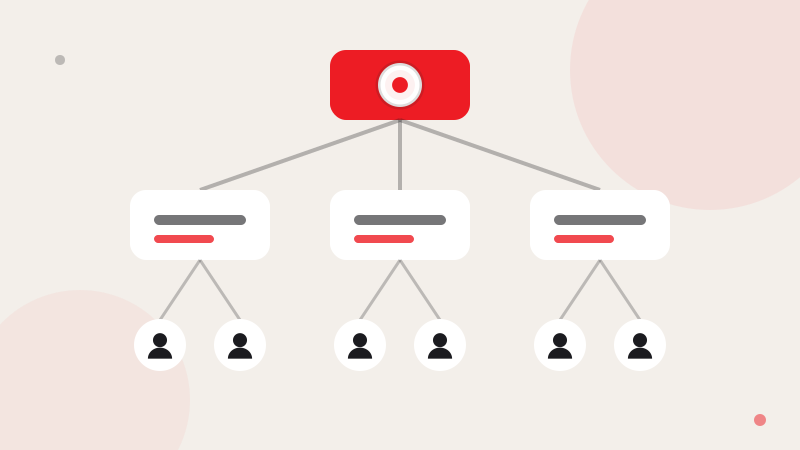
Goal cascading means linking goals at every level of the organization, from company to team to individual:
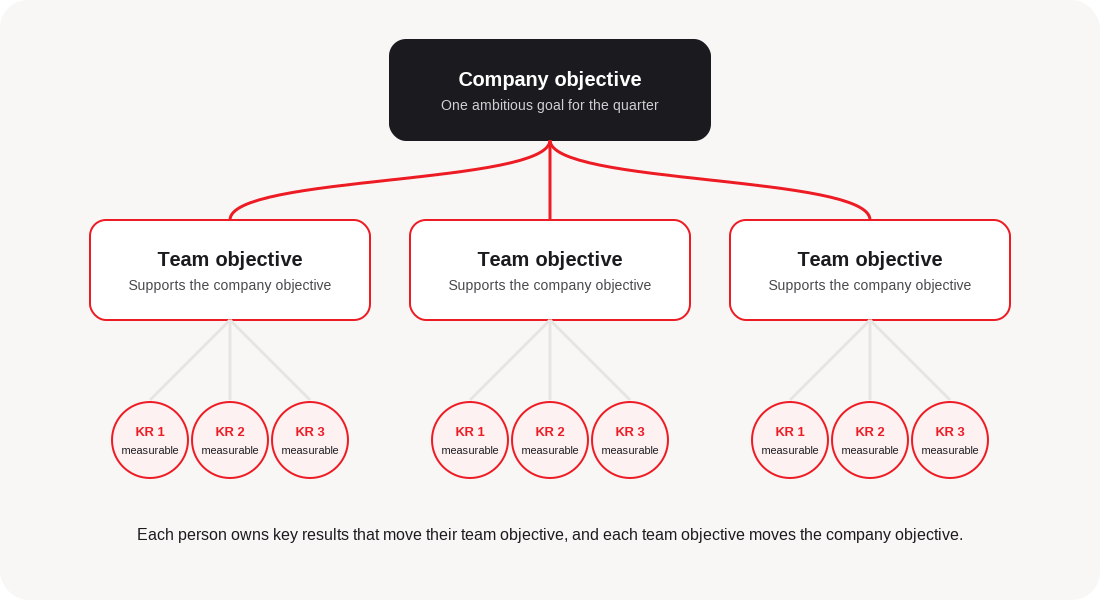
Cascading goals improve transparency, alignment and accountability, and they help the business grow. Picture a relay team: every runner matters, and the baton has to pass cleanly from one to the next. A fast runner who heads the wrong way still costs the team the race.
Elon Musk has described employees as “vectors”: when everyone points the same way, their efforts add up; when people pull in different directions, they cancel each other out.
When individuals, teams and departments all work toward the organization's top-level goals, everyone moves in the same direction, and each contribution builds on the others until the goals are reached.
Now that you know what team goals are and why they matter, the rest of this guide shows you how to set them.
This guide is for executives, HR and people teams, managers and individual contributors who want stronger alignment, better results and a more engaged, motivated team.
A clear vision and company goals
What is your organization's mission, and where do you want to be in three to five years? You should be able to answer both clearly. If not, start by clarifying your company vision and strategy.
Team goals exist to help the company reach its goals, so keep the company-level picture in front of you as you plan for your team.
- Celebrate wins along the way. It keeps people motivated and shows them their effort is noticed. There are many ways to do it, and recognition makes a real difference to engagement and retention.
- Make company and team goals visible to everyone. Goals are meant to create alignment, which only works if people can see them. A simple goal map that shows how goals connect and who owns each one helps a lot.
- Be precise and use numbers. Key results must be measurable so you can track progress and know when to adjust course or stretch further.
- Avoid open-ended results such as “keep growing our newsletter list.” That is not a key result. Set a concrete target instead, for example “grow our newsletter list to 15,000 subscribers by the end of Q3.”
- For the same reason, avoid words like “continue” and “maintain” in team goals. Key results should push you forward. The exception is a situation where holding steady is the real challenge, such as keeping customer numbers stable during a downturn.
- Use the SMART test when writing OKRs: every objective and key result should be specific, measurable, achievable, relevant and time-bound.
Start with the company-wide goals and ask how your team is best placed to help achieve them.
The team's manager can sketch an initial draft, but the final goals should be shaped with input from the whole team.
At this point, aim for a long list of possible contributions. Your initiatives will need to be measurable eventually, but don't set targets or numbers yet; that comes in the next step.
Run a brainstorming session with your team to agree on objectives that support the company's goals. The OKR approach suggests three to five objectives per quarter.
For more detail on writing strong objectives and key results, see our guide to implementing OKRs.
Keep the distinction in mind: objectives are what you want to achieve; key results are the checkpoints that show you are getting there.
Say you lead marketing at a fictional jam maker, and one Q2 objective is to build brand awareness in a few target markets. Key results might include:
- Launching X new campaigns;
- Growing organic website traffic in those markets by Y%;
- Signing Z local food bloggers as brand partners.
The chart below shows a sample set of company goals for another quarter, with key results contributed by several teams:
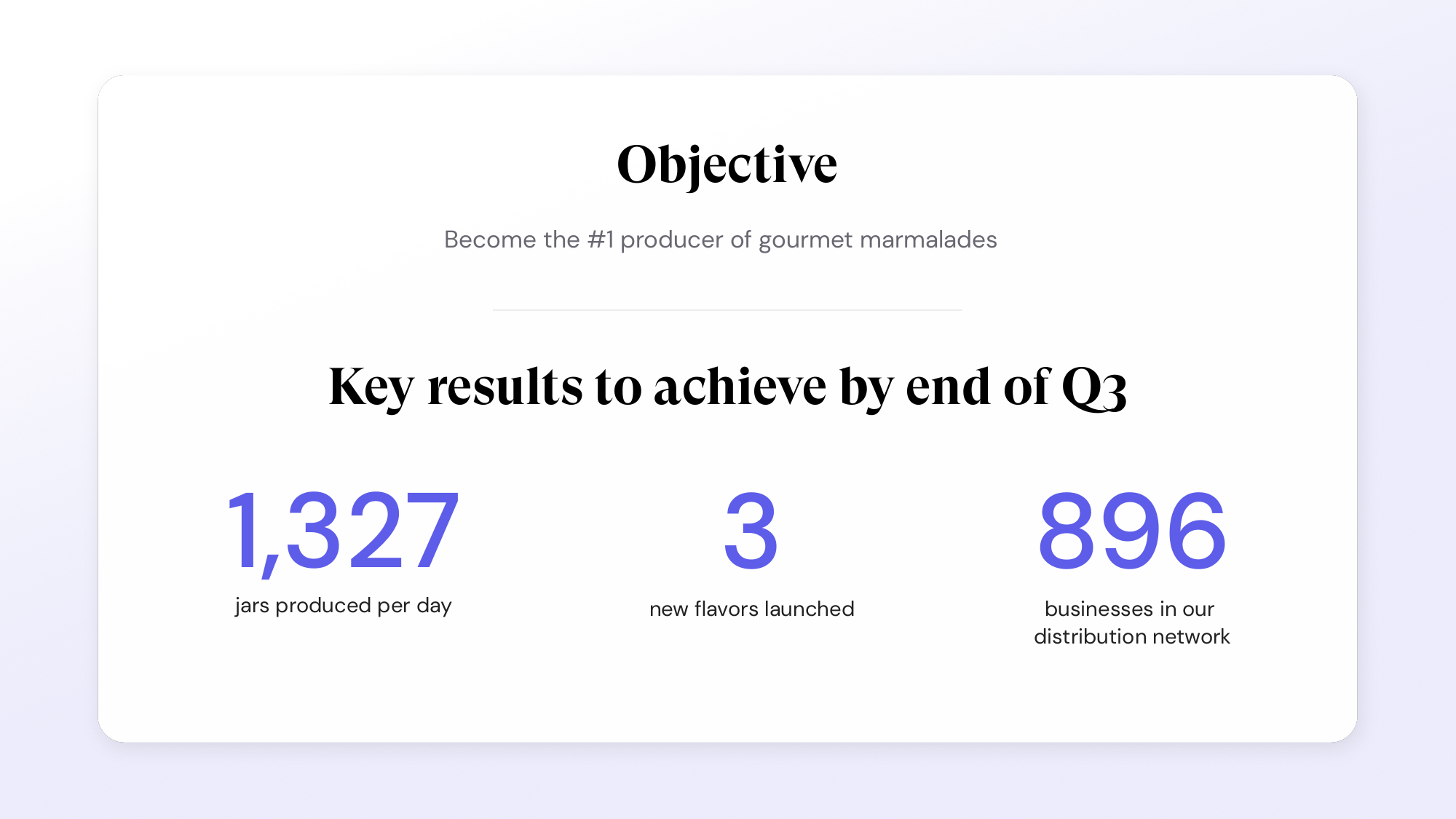
Here is how some of the company's departments might support the company-wide goals in Q3:
Product development
- Research consumer taste trends (month 1);
- Create six new recipes (month 1);
- Test the six recipes with consumer panels (month 2);
- Finalize the top three recipes for launch (month 2).
Operations
- Hire 15 production staff to support higher output (by the end of month 2);
- Upgrade the production line for greater capacity (by the end of month 2);
- Buy the equipment needed for the new recipes (by the end of month 2).
Marketing
- Open two new social media accounts;
- Plan and run a print and outdoor campaign;
- Design and launch an in-store tasting campaign.
Sales
- Present the new range to 2,500 prospective retailers and distributors;
- Enter two new regions, with at least 20 distributors signed in each.
Every key result needs one team member who is responsible for delivering it. Team goals are meant to show people that their work matters, so give them room to propose initiatives and choose the ones they want to own. People who pick their own key results tend to care more about delivering them.
There are many ways to support your team. Make sure people have the resources they need, and offer help throughout the quarter. For some individual contributors, it may make sense to build a short action plan together.
Holding regular OKR check-in meetings, every two to four weeks, is one of the best ways to keep your team's goals on track. Track progress somewhere everyone can see it, whether that is a shared spreadsheet, a dashboard or the goal-tracking tool your organization already uses.
Alongside check-ins and shared progress tracking, talk about individual initiatives in one-on-one meetings and give regular feedback.
Want to go deeper on company and team goals? Read our complete guide to implementing OKRs.
Alignment happens when people can see how their goals connect to the company's direction and feel supported in pursuing them.
A simple goal map, showing company objectives at the top and team and individual goals beneath them, makes cascading goals easy to understand. Your employee survey can then tell you whether people feel clear about priorities, and goal alignment is one of the practices the Best Places to Work certification looks at.
Company-level goals may run for a year or more, but quarterly cycles work best for team and individual goals. A quarter is roughly 13 weeks: long enough to make steady, measurable progress each week, with a couple of weeks of slack at the start to get going and adjust your plans.
Yes, when needed. Goal-setting should be thorough enough that changes are only made when new information comes to light or circumstances shift. Adjusting objectives or key results mid-cycle is not a sign of failure.
If key results turn out to be unrealistic, scale them back. And if your team is close to hitting its targets just weeks into the cycle, raise the bar a step or two.